Showing posts with label tomato. Show all posts

Sunday, October 3, 2010

Central Coast Tomato Taste Tests 2010 - Black Zebra

The next tomato up on the chopping block is Black Zebra.

Seed Catalog Description:
A natural and stabilized cross between Green Zebra and a black tomato by Jeff Dawson. This is one of the STARS of my whole tomato showcase. A proven success with markets and friends. Our TomatoFest organic tomato seeds produce vigorous, indeterminate, regular-leaf tomato plants that produce 4 oz., 1 1/2", juicy, round tomatoes with purple/mahogany-colored skin with green stripes (like brush strokes) with exceptionally rich, complex, really delightful tomato flavors that contain hints of smoke and sweetness. Its flavor also carries the rich complexity associated with the best of black tomatoes. This this is one of our favorites for looks and taste. A winner! Once tried, you will keep this black tomato a place in your garden.

Production and Earliness: 
Black Zebra hasn't produced many fruit so far...only a couple of handfuls in the last few weeks.  I imagine that it will only produce a few more fruits this year, judging by the amount that has set on the plant.  Not an early variety...mid- to late-season.
Fruit Size, Color, and Shape:
The fruit size is quite small: from 0.5 to 1.5 ounces.  I have a hunch that these tomatoes would be bigger if they had been grown in a hot summer climate.  The color is beautiful!  The picture above doesn't do them justice.  They are striped a deep red and dark green.  The shape is round with some top- and bottom-flattening.

Plant Growth Habit:
The Black Zebra plant has grown to a medium height.  Unfortunately, it's not very vigorous and has been strongly affected by some type of disease.  I only grew one plant this year, so it's possible that a larger sample size might have produced some healthy plants.

Texture:
Good texture.  The skin was a little bit thicker than I like.

Taste:
Delicious!  I tasted Black Zebra, Green Zebra and Paul Robeson together and Black Zebra won for me.  It has a complex punch of flavors.  The citrus flavor of one of parents (Green Zebra) comes through and there's also a nice "black" flavor.  Sweetness is also there to balance the acidity.   Really rich flavor when a bit of salt is added.

Cooking and Serving option:
Perfect for slicing into salads or eating right off the vine! 

Is it a winner?
If I had a garden that was big enough I would definitely grow this plant every year simply because of the outstanding flavor it has.  As it stands, I plan to try it again next year and see if it grows stronger and produces more fruit.  (Oh please let it be so!)


Thursday, September 23, 2010

Central Coast Tomato Taste Tests 2010 - Japanese Black Trifele

Well, it's time to (finally!) begin the "Central Coast Tomato Taste Test 2010" series!  It's been a recording-breaking cold summer and the tomatoes are showing the effects of low temperatures.  Less fruit has set on the plants and the tomatoes stay green on the vine for what seems like an eternity.  I have a hunch that the flavors of the tomatoes for this year will be biased towards bland.  So, any variety that tastes good this year will probably be a real winner in a normal year.  

A bright shining star of my tomato garden has been Japanese Black Trifele.
Seed Catalog Description:
Russian origin. In Russia the Trifele varieties of tomatoes (of which there are several colors) are highly prized and command high prices. This short potato leaf plant yields prolific quantities of 6 oz. fruit that looks like a beautiful mahogany-colored Bartlett pear with greenish shoulders. Very tasty flesh with a meaty core that produces luscious fruit all summer long. A work of art sliced out on a plate and a wonderful flavor that possesses an extraordinary rich and complex flavors. The Black Trifele is one of the blackest varieties available and is resistant to cracking.

Production and Earliness: 
This variety is currently the 3rd highest for pounds of fruit produced.  However, when I look at the plants and see all of the large green fruit, I'm very sure that by the end of the season, it will be the heaviest producer.  I didn't grow Lahman Pink this year, which was a heavy producer last year, so I can't compare the two in terms of production.  In terms of earliness, the first fruit was picked on 8/29, which is not bad considering the cool temperatures.  I can classify it as a mid-season variety.

Fruit Size, Color, and Shape:
The fruit size is typically between 2-6 ounces.  The color is a "light black", meaning that it is mostly red with some greenish shoulders sometimes.  The shape would probably be somewhere between a large egg and a pear.  In my garden a lot of the fruit have been "doubles".  I haven't noticed any cracking and very little cat-facing.

Plant Growth Habit:
The seed catalog description says that it is a "short" plant, but mine is not really short.  It's not 9 feet high like some of my plants, but it's definitely taller than a determinant variety.  I'm really glad that I let several early suckers grow because they are producing lots of fruit.

Texture:
Mmmm...it's silky.  Nice thin skin.
Taste:
Quite nice.  I would say it's a mild black flavor.  It's not as complex as, say, Paul Robeson.  But it's sweet with very little acidity.  Salt definitely punches up the flavor.  Without salt, it's a little bland.

Cooking and Serving option:
It's pretty juicy, so probably best used as a slicer.  Might make a nice fresh pasta sauce, but probably not worth it to try to can the sauce.

Is it a winner?
Right now, I'm seeing this variety as a "insurance policy".  That is, insurance against a tomato-less summer.  It is producing (relatively) large, nicely-flavored fruits in abundance.  And for that I am grateful.  I'll definitely grow this variety again next year.
 

Friday, August 6, 2010

What a long, strange, trip it's been

It's been a cold spring and summer. In fact, it's been the coldest July on record and one of the top 3 coldest Junes. But, you don't have to ask the weatherman to find this out. Just look at my garden. I've only picked 3 ripe tomatoes so far. The plants were started from seed in late January and planted out during the first half of April. Four looong months later, on August 3, I picked the first one - a Costoluto Genovese.

This is the first tomato of the year, just a few days before I picked it.

Costoluto Genovese

Japanese Black Trifele

August 3 is a full month later than I got my first ripe tomato last year! (And I even set out my plants about a week earlier this year.) A lot of blossoms aren't setting.

Principe Borghese is good about setting fruit in cold weather. (Way to go! You sweet little Italian heirloom, you!)

On the bright side, the beans are growing well. Especially, the Scarlet Runner beans.

Witness the chicken damage below knee-height :) The girls love their greens.

Plus lots of zucchini (surprise).


And several nice-looking spaghetti squash.


Cucumbers are painfully slow.

I still have some lettuce that's growing pretty well, this is Gentilla (green) and Lollo Rossa (red).
I hate the ugly, chicken-deterrent cages, but at least I'll have lettuce to pick.

Here are the recent additions. Two hardy kiwis: the male is on the left and the female (Ken's Red) is on the right. Also, 2 everbearing red raspberries in the center: Jaclyn (left) and Caroline (right). Jaclyn has buds right now.


I'm proud of myself for actually remembering to put in some flowers:


Thursday, June 3, 2010

Tomatoes, carrots, and strawberries

These strawberries (Eversweet) are a big hit with any kid who comes over to my house. They are an everbearing variety that I picked up at OSH for $1 on a whim. These 10 plants have produced over 3 lbs so far this year. Although the number is probably somewhat higher in actuality, due to the aforementioned kids :) I'm using the upside-down strawberry crates and wooden/concrete blocks as a place to prop the developing berries upon. Since we've had so much rain this spring, I didn't want them to rot in all the water. I thought about planting them on "hills", like the commercial growers do, but I wasn't sure how to make that happen exactly in a raised bed. This method seems to be working ok. I just prop a couple of berries up when I walk by.

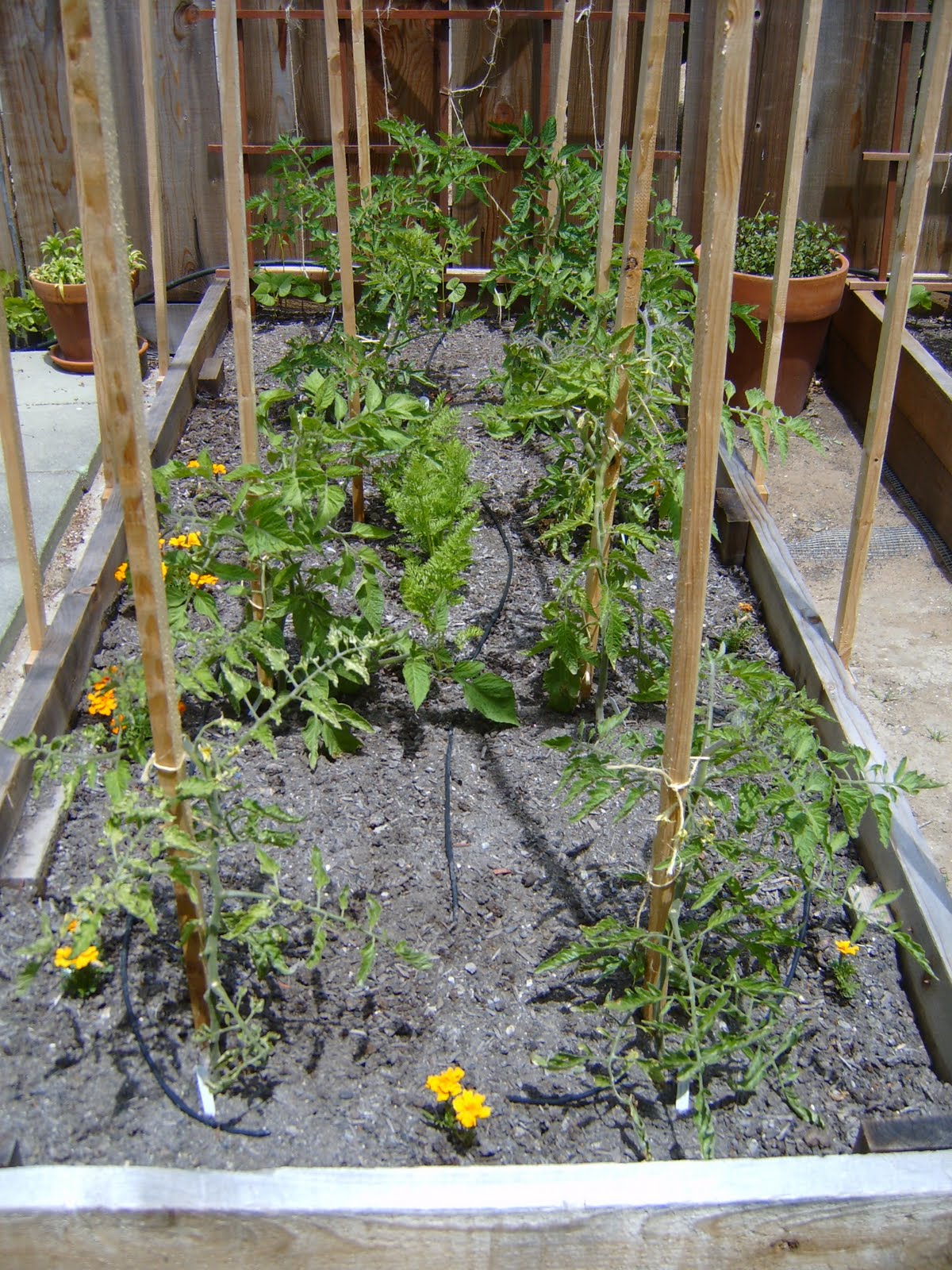
This bed is currently holding beans at the very back, then tomatoes, then tomatillos, then basil, amaranth (from Michelle, for greens), and one Greek oregano plant at the front. Again, I'm using the plastic strawberry crates to keep the birds from damaging young seedlings. The other crop which I squeezed in is carrots - you can see them in a straight row down the center. They were planted like this in February, since I knew that tomatoes and tomatillos would be going in on the edges later in the spring. It's worked out well planting them this way because they will be ready to pull before the tomatoes shade them out.


This bed has (again) beans in the back, then 8 more tomatoes, with a few carrots in the center. I'm also using marigolds around the tomatoes because they are supposed to ward off aphids. This is the second year in a row that I have done this. And although I see a few aphids, they haven't been a problem for me. Maybe it's working?!

Last year I picked the first ripe tomato on July 4. I doubt that it will be so early this year, since we've had such a cool, wet spring. But that's ok, the plants are growing well and we'll have tomatoes at some point this summer. I'm still eating dried tomatoes from last year, so we are definitely not destitute and tomato-less, yet!

Thursday, February 11, 2010

Tomato germination


Annndddd, they're off! We've got tomato germination, friends.

Last year, I started seeds at the very end of January. This year, I held off till February 2. A friend who lives "in the valley" made me wonder if I'm behind...she started hers the 2nd week of January! The only varieties that haven't germinated yet are Sungold F3 and Paul Robeson. I actually talked to them last night, in an effort to persuade them to sprout. It's a scientifically valid method, especially as I am female, or so I hear.

I'm planning on growing 18 plants, but I started 24. Six are alternates. In case one of my "first string" plants has a problem/injury, I'll put in alternate who is sitting "on the bench".

Here is a list of my varieties for this year. If I'm growing > 1, there will be a number in parenthesis:

amish gold (4)
black cherry
black zebra
camp joy
costoluto genovese
green zebra
japanese black triefle
lahman pink
paul robeson (2)
poland II (2)
principe borghese
sungold F3 (2)

Sunday, January 17, 2010

Tomato seeds...yes, I really needed more

My order from TomatoFest arrived a few weeks ago, but I'm just getting around to showing it off. New varieties include:

Principe Borghese - Italian, good for paste and maybe drying

Black Zebra - love Green Zebra and thought I'd give the "black" version a try as well

Poland II - a paste tomato that seemed like a good choice

Amish Gold - most excited about this one! It's a stabilized cross between Sungold and Amish Paste

Black Cherry - cherry tomatoes grow well here and I love the flavor of many "black" tomatoes

Japanese Black Trifele - I've heard the flavor is incredible

Yellow Stone - a freebie...what a bad name for a tomato!

I love the selection from TomatoFest! You can spend all day there :) Although, I do wish the seed packets had pictures of the actual variety, like on the website. But it would probably cost more to do that, so maybe it's not worth it.

I'm in the process of allocating garden space to each variety. I know that I want to grow more paste tomatoes for saucing...Amish Gold I'm thinking of you. But do I really want to give a lot of precious, central coast, real estate to a newbie?

Thursday, October 1, 2009

Central Coast Tomato Taste Tests 2009 - Paul Robeson

The next tomato in the taste test series is Paul Robeson.

Paul Robeson, the man for whom the tomato was named (from Wikipedia):
Paul LeRoy Bustill Robeson (April 9, 1898 – January 23, 1976) was an American actor of film and stage, All-American and professional athlete, writer, multi-lingual orator, lawyer, and basso profundo concert singer who was also noted for his wide-ranging social justice activism. A forerunner of the civil rights movement, Robeson was a trade union activist, peace activist, fellow traveler, Phi Beta Kappa Society laureate, and a recipient of the Spingarn Medal and Stalin Peace Prize.
Sounds like a cool dude!

Seed Catalog Description:
Seed for this Russian heirloom was made available by Marina Danilenko, a Moscow seedswoman. This favorite tomato was named after the operatic artist who won acclaim as an advocate of equal rights for Blacks. His artistry was admired world-wide, especially in the Soviet Union. This "black" beefsteak tomato is slightly flattened, round, and grows to 4-inches. It’s deep, rich colors stand it apart from others…a dusky, dark-red, with dark-green shoulders, and red flesh in it’s center. Very flavorful fruits with luscious, earthy, exotic flavors and good acid/sweet balance. Paul Robeson (aka Pol Robeson) won "Best of Show" at Carmel TomatoFest. As this variety originates from Siberia and sets fruits at lower temps, it is an excellent choice for cooler growing regions.

Production and Earliness:
My plant has produced 24 tomatoes so far this season. The total production weighs in at 5 lbs. I picked the first ripe tomato on 8/03/09.

Fruit Size, Color and Shape:
On average, the fruits weigh 3.4 ounces each, though the size varies quite a bit. They are prone to "funkyness" on the bottom:

It's hard to categorize the color of this tomato...reddish, mahogany, greenish, orangish. Each tomato is different. Some have an orange "base color" when ripe and others have a red "base color".Plant Growth Habit:
This plant is regular-leaved. It was relatively more susceptible to the disease that affected my tomatoes this year. (I don't know for sure what the disease was, but I'm guessing early blight.)

Texture:
The texture is a little bit mealy and somewhat crumbly.

Taste:
The taste is hard to describe. It's earthy, slightly citrusy, medium-low acidity. Each bite is different! Because the fruit ripens to different colors, the flavor of each tomato is a bit different. I like the flavor - definitely. But it's hard to put it into words.

Cooking and serving options:
It's a slicer, through and through.

Is it a winner?
I like the flavor a lot. I appreciate the fact that every tomato tastes slightly different, but all are good. Drawbacks include the low yield and the fact that disease symptoms showed up early and strongly. In spite of this, I'll be growing it again next year because of the "delicious factor".

Sunday, September 27, 2009

Tomato Lady

A couple of friends from Oakland stopped by our house recently. They had been touring Monterey all day with some other friends from DC. One of the male urbanites saw my "tomato table" and asked to try one. I said "Sure", since there were only about a hundred on the table.
The table of "honor and glory"!

Then, here it comes..."That's the best tomato I ever tasted!" says the urbanite.

I beamed.

Later that day, I found out from my friend that the tomato taster had nicknamed me "The Tomato Lady". Oh, yes, this made me happier than if he had nicknamed me "The Beautiful Lady from Monterey".

Mother Earth News is conducting a survey of all US tomato growers by region. Anybody who wants to participate can click here: http://www.surveymonkey.com/s.aspx?sm=e1HH0dD96LHer4kqCFZFpQ_3d_3d. A summary of the results thus far is here. Mother Earth News plans to write up the final results for the February-March 2010 issue.

I wish they would have split up the regions a bit more. I'm included in the "Southwest" region for the survey, but I can guarantee you that I've got little to nothing in common with folks in Arizona.

Friday, September 25, 2009

Central Coast Tomato Taste Tests 2009 - Early Girl F2

The next tomato I'm tasting is Early Girl F2. I saved see from a (hybrid) Early Girl tomato last year. This year I planted out two F2 seedlings. They are vastly different from each other! The one I'm tasting today has potato leaves and produces enormous (for me anyway) tomatoes up to 1.25 lbs. I named this one "Early Girl F2 East", since it grew east of the other seedling. (The other, regular-leaved plant produces small tomatoes.)

Seed Catalog Description:
No description, since it's an F2 (offspring of a hybrid). F2 is the abbreviation for the second filial generation.

Production and Earliness:
Early Girl F2 East produced the first ripe tomato on 7/24 - not bad for a huge beefsteak type tomato. I have collected 27 tomatoes from this plant weighing a total of 11.2 lbs.

Fruit Size, Color and Shape:
Ruffles galore. They are pretty, no doubt, but can make slicing complicated when catfacing occurs on the blossom end. The average tomato weighed 6.6 ounces. This plant definitely produced the largest tomatoes in my garden this year.

Plant Growth Habit:
Big, bushy and heavy plants. They need a strong support.

Texture:
Typical beefsteak texture. Not the greatest, but not bad either.

Taste:
They have a good flavor that is enhanced by salt. Medium acidity. Most of the flavor is in the gel, but the meat isn't bland. Traditional tomato taste.

Cooking and serving options:
This is a big slicing tomato. But I wonder what it would be like stuffed and roasted... Some of them are too much tomato for one person to eat in one sitting, so better to grab a friend.

Is it a winner?
The taste is good and the size is great. It's relatively early and has heavy production. Since there is no way to know what the offspring (F3) will be like, I'll probably have to grow out a few of them due to my curious nature.

Monday, September 21, 2009

Central Coast Tomato Taste Tests 2009 - Stupice

The next tomato up is Stupice.

Seed Catalog Description:
This potato-leaf heirloom from Czechoslovakia is a cold-tolerant tomato that bears an abundance of very sweet, flavorful 2 to 3-inch, deep red fruit. A 1988 comparative tasting in the San Francisco area gave it first place for its wonderful sweet/acid, tomatoey flavor and production.
Days: 52
Size: Indeterminate
Color: Red
Season: Early-Season
Type: Heirloom

Production and Earliness:
Stupice is my queen of earliness this year. The first ripe tomato was picked on 7/4. I'm growing 2 Stupice plants this year and the average number of fruits per plant is 139 weighing a total of 8.65 lbs.

Fruit Size, Color and Shape:
The average Stupice tomato weighs one ounce, but in reality there is quite a range of sizes. My plants have produced tomatoes between 0.5 ounce to ~2 ounces or so. The shape is also variable from roundish to heart shape. They seem to be prone to fasciation, but that doesn't bother me. The color inside and out is the classic red.

Plant Growth Habit:
Stupice is a potato-leaved variety. The plants are around 6 feet tall.

Texture:
Good texture. Average meat to juice ratio.

Taste:
Stupice has a good, bright and sweet taste. It is similar to Camp Joy, but not quite as flavorful. Medium acidity.

Cooking and serving options:
Hmmm...Stupice is a "jack of all trades, master of none" type of tomato as far as cooking and serving goes. It doesn't really lend itself to any particular purpose, but slicing for a side dish, salad, or sandwich would work just fine.

Is it a winner?
I feel like I'm really supposed to love Stupice. I've heard other people talk about how great it is and it's been hyped as great for the cool, coastal climate. It is good, but it's definitely not my favorite. I did appreciate it's earliness - first in the garden to ripen. But Camp Joy is similar in size to Stupice and I like it's flavor better. I hate to let Stupice go unplanted next year, but I just might do it.

Thursday, September 17, 2009

Central Coast Tomato Taste Tests 2009 - Camp Joy


The next tomato up is Camp Joy.

Seed Catalog Description:
Heavy bearing heirloom variety that offers an abundance of luscious 1" fruit with huge, well-balanced, sweet tomato flavors. One of Gary Ibsen's favorite cherry varieties. Strong disease resistance. Perfect for snacking or salads.
Days: 81
Size: Indeterminate
Color: Cherry
Season: Mid-Season
Type: Heirloom

Production and Earliness:
Camp Joy produced a ripe tomato on 7/8. Great, I thought! But then my 2 plants made me wait until 7/24 for another taste. So I consider this pretty good earliness. The average plant has produced 96 tomatoes so far, weighing 3.27 lbs.

Fruit Size, Color and Shape:
This is a small sized tomato, think cherry to golf ball range. They are nice, round, and red. The average Camp Joy tomato weighs half an ounce. I like how all of the Camp Joy tomatoes are a similar size - there are very few little runts. This doesn't seem to happen with most of the other varieties I'm growing, which have a much larger range of sizes.

Plant Growth Habit:
These plants can grow! The catalog description says they have "strong disease resistance". I think their strategy is to simply outgrow diseases. I'm thinking that if my plants weren't growing all over the place, but were instead tied to a really tall stake, they would be 12 feet tall by now!

Texture:
Lots of gel and seeds and juice. Rather creamy texture - nice.

Taste:
They have a nice, sweet flavor with a hint of earthy-ness. There is medium acidity and salt enhances the flavor. Most of the flavor is contained in the gel, not in the 'meat'. I really liked the flavor and so did my husband. We both picked Camp Joy over Lahman Pink and Nepal.

Cooking and serving options:
Camp Joy is a snacking tomato, and a darn good one. Though it's not meaty enough to be considered for sauce, that's ok. I've enjoyed slicing the larger ones for topping my tomato sandwiches. And the smaller ones are great in salads.

Is it a winner?
I like this tomato. The great, sweet flavor and (relative) earliness are it's best qualities. I'll likely be growing this one again.

Saturday, September 12, 2009

Central Coast Tomato Taste Tests 2009 - Lahman Pink


The next tomato up is Lahman Pink.

Seed Catalog Description:
a.k.a. Grace Lahman's Pink. A TomatoFest favorite. One of the most popular tasting tomatoes at the Heirloom Garden Show. Our Tomatofest organic tomato seeds produce indeterminate, big, regular-leaf plants that yield tremendous amounts of 10-12 ounce, blemish-free, smooth, meaty and juicy, pink tomatoes that are richly sweet with a clean slightly acidic finish in the mouth. This tomato bears heavily until frost. Great tomato for slicing fresh or canning whole. Highly recommended as a farmer's market tomato because of the visual appeal and flavor. A good tomato for cooler growing conditions.
Days: 80
Size: Indeterminate.
Color: Pink
Season: Mid-Season
Type: Open Pollinated

Production and Earliness:
My Lahman Pink tomato plant has produced 10 tomatoes so far. The first tomato was ripe on 8/11 - very late, since the first ripe tomato I picked this year was on July 4.

Fruit Size, Color and Shape:
It's red! I don't know why they called the tomato a 'pink'. My picture isn't the greatest, but I promise you, it's red. Lahman Pink has produced 2.96 lbs and the average tomato weighs 4.75 ounces. The shape is very ruffled and quite pretty to look at.

Plant Growth Habit:
A bushy, full plant, but not reaching for the stars.

Texture:
Meaty, few seeds. Lahman Pink has a creamy texture - nice.

Taste:
It has classic, good tomato flavor, but there is a heavy, acidic, aftertaste 'kick'. I'm not sure I really like that much acidity, it kinda burns my mouth. Salt enhances the already nice flavor. Most of the flavor is in the walls of the tomato, not as much as in gel. This is quite unusual for tomatoes, as far as I can tell.

Cooking and serving options:
This is a good slicing tomato, but it would also be great for sauce because of it's meaty-ness. The only problem is low production. I'll have to wait to see the total production at the end of the season, but I'm thinking Lahman Pink won't be a stand-out.

Is it a winner?
Hmm...it's got good flavor, but maybe a bit too much acid for me. It's got great creamy texture, cute curves, and lots of "meat" for saucing. If the total production comes out at least average, then I'll probably grow it again.

Sunday, September 6, 2009

Central Coast Tomato Taste Tests 2009 - Nepal


The next tomato up is Nepal.

Seed Catalog Description:
Originally from Farmers Seed Co., from India's Himalaya Mountains. Big sprawling plant pruducing abundant crop of 6 to 10 -oz., smooth, round, scarlet-red fruits with little cracking and intense sweet tomatoey flavor. A great keeper if picked green late in summer and allowed to ripen when wrapped in paper.
Days: 75
Size: Indeterminate
Color: Red
Season: Mid-Season
Type: Heirloom

Production and Earliness:
My one Nepal plant has produced 14 tomatoes thus far in the season. They weigh in at a total of 5.28 lbs or ~6 ounces each...not bad for a central coast plant! The first tomato was picked on 7.24, which is kinda late.

Fruit Size, Color and Shape:
Nepal has an orangish-red color when ripe. The inside is a bit pinkish. The shape is nice and round - no ruffles here.

Plant Growth Habit:
Nepal isn't a mountain climber, thought the name might suggest differently. My plant is only about 6 feet tall and relatively compact.

Texture:
Nepal is a firm tomato, definitely non-mushy.

Taste:
There is very little flavor in the "walls" of the tomato, practically all of it is in the gel. There is quite a bit of acidity, yet the taste is simply not there.

Cooking and serving options:
Since there's not much flavor, I can't get very excited about serving options.

Is it a winner?
Sadly, not a winner. I had hoped that this variety would have a great taste, especially since it produced pretty large tomatoes in my garden - some weighed almost a pound. Ah, well. The search continues!

Wednesday, September 2, 2009

Central Coast Tomato Taste Tests 2009 - Sungold F2

The 2nd taste test for 2009 is Sungold. I'm actually growing and tasting an F2 plant because the original Sungold is a hybird. Sungold has a reputation for great taste and heavy production, even in cool weather.

I realize that this taste test is a little bit irrelevant in some respects, being that is a test of an F2. But it's important to me, since I love Sungold and I love open-pollinated plants. I have a mission to create an open-pollinated Sungold-like-plant. So, I going to continue to try and stabilize an OP version by selecting the best plant each year and saving seed. Eventually, I hope to have a great OP Sungold. When I get this future strain, I'll name it Sungold-OP. Or maybe Jackie's Lucky Sungold OP. Or...maybe I'll buy a race horse and name it that ;)

Anyway, the next tomato in the taste test series is Sungold F2.

Seed Catalog Description:
There is none. I got a hybrid seedling from a neighbor who bought too many for his garden last year. I saved seed from the 2008 plant and planted it out in 2009. I was able to fit in 2 Sungold F2 plants. One produced red (not the characteristic orange) fruit and is ok, but not great. The other is awesome! It produces bigger and more fruit than the original plant from 2008. It has incredible branching inflorescences that are loaded with fruit. This is the plant I'm reviewing here.

Production and Earliness:
My plant has produced 304 (dang!) tomatoes so far this season (first part of Sept.). The total production weighs in at 5.6 lbs. On average, the fruits weigh 0.3 ounce each. (Hey! It's a cherry tomato!) I picked the first ripe tomato on 7/08/09.

Fruit Size, Color and Shape:
This Sungold F2 produces bright, orange, cherry-sized tomaotes. They are dime- to half-dollar sized. Most fruit are quarter-sized. They are 'well rounded'. When sliced, they have a peachy-yellow coloring inside. If eaten when slightly under-ripe, the inside will be green and yellow. Slightly under-ripe Sungolds are golden with green shoulders.

Plant Growth Habit:
This Sungold F2 is not shy about it's height. It is currently about 9 feet tall and has regular tomato leaves.

Texture:
There is little juice in Sungold, but instead it is more meaty.

Taste:
The taste is citrusy and punchy. It is medium-high in acidity. If eaten when slightly under-ripe, the flavor is really strong with even more acidity. I prefer to eat them when they are fully ripe and, therefore, fully orange. Salt weakens the flavor somewhat.

Cooking and serving options: I usually just eat them fresh. But I've also halved them and used them as a topping for homemade pizza - yum. There have been so many this year, that I've also dried some in the dehydrator.

Is it a winner?
This Sungold F2 is a winner in my book! I'm hoping that its progeny (selfed) will be very similar to the parent plant. It produced early and heavily. And the flavor doesn't quit. I like a tomato with some kick and Sungold F2 has it. I'll definitely be growing out a few of the F3 generation next year.

Saturday, August 29, 2009

Central Coast Tomato Taste Tests 2009 - Glacier

Welcome to the first edition of the "Central Coast Tomato Taste Tests 2009". I was inspired by Hanna's awesomeness. In fact, I found her "Tomato Tastings" so helpful that I decided to produce similar posts about the tomatoes I'm growing. Of course, these posts will have a special emphasis on cool-summer/early varieties. This is due to the non-tomato-y weather we have here on the Central Coast of California. So, without further ado, let the tasting begin!

The first tomato up on the chopping block is Glacier.

Seed Catalog Description:
An early, short-season, open-pollinated, potato-leaf variety that flowers when it is only 4-inches tall then sets loads of very flavorful 2 to 3-ounce, round, red tomatoes. Good flavor.
Days: 65
Size: Indeterminate
Color: Red
Season: Early-Season
Type: Heirloom

Production and Earliness:
My best plant has produced 91 tomatoes so far this season (end of August). The total production weighs in at 5.7 lbs. On average, the fruits weigh 1 ounce each. I picked the first ripe tomato on 7/21/09.

Fruit Size, Color and Shape:
Glacier produces lots of golf-ball-sized fruit. These tomatoes are bright red and they are mostly round, but can be heart-shaped or horizontally flattened.

Plant Growth Habit:
Glacier is a potato-leaved variety. It has sparse foliage and does not grow to great heights. My plants have stayed under 6 feet tall. It produces several branching inflorescences (flowering branches).

Texture:
Glacier is juicy, especially considering the small size. There is a lot of gel.

Taste:
Glacier is a sweet tomato with low acid. A pinch of salt really brings up the flavor. The taste isn't "knock your socks off", but it is pleasantly tomato-y.

Cooking and serving options:
Glacier is a bit limited in the cooking/serving department. The small size is fine for slicing as a side dish or topping a pizza. It is not a meaty tomato, but instead tends toward the more juicy end of the spectrum.

Is it a winner?
Glacier has an interesting growth habit, with is short stature and sparse potato-leaves. It would be good for a small garden or for people who don't want to get out ladders to pick tomatoes ;) Kids would be able to see all of the action up close.

Glacier is a pretty good producer in our cool climate. It has produced the 3rd highest poundage after Stupice and Early Girl. Notice how the seed catalog description said "good flavor". They didn't say more because there's really nothing left to say. It's not bad, but it's not great. I might grow Glacier again because it seems to produce well in a small space, but there are definitely better-tasting tomatoes for the heat-challenged.

Wednesday, August 19, 2009

Central Coast Tomato Trials - part 8

At this point in the trials, I have picked over 30 lbs of tomatoes. The heaviest producer is Stupice, with an average of 47 tomatoes per plant, totaling 3.61 lbs.

Following closely are:
Glacier (58 tomatoes totaling 3.68 lbs),

Sungold F2 (185 tomatoes totaling 3.50 lbs), and

Paul Robeson (10 tomatoes totaling 3.39 lbs).
Some notes on the cool-summer varieties that I'm growing:
Camp Joy - a small red tomato; the first to set fruit; good flavor
Early Girl F2 - 2 plants vary wildly. One has jumbo tomatoes and regular leaves; the other has several small-medium tomatoes and potato leaves.
Glacier - a compact plant that's only 4 feet tall and rather narrow; it has potato leaves and is a heavy producer of small red tomatoes; good flavor
Lahman Pink - the latest to produce ripe fruit; light red tomatoes of various sizes; ok flavor
Nepal - slow to produce fruit; red tomatoes of various sizes, some large; good flavor
Paul Robeson - slower to produce ripe fruit; multi-color, from maroon to green to orange; medium and small fruit; BEST flavor so far
San Francisco Fog (F2?) - slow to produce fruit; leaves curled upward; light producer
San Marzano F2 - slow to produce fruit; red paste tomatoes, most are quite large; good flavor
Stupice - first to produce ripe fruit; smallish-medium red tomatoes; meaty, good flavor
Sungold F2 - 2 plants vary wildly. One has small red cherry tomatoes, but very few. The other is fantastic with loads of delicious, large, orange cherry tomatoes.
Sweetie - not growing well or producing well; small red cherry tomatoes

Monday, August 17, 2009

Seed --> Plant --> Tomato --> Sauce

I made 6 pints of tomato sauce from all of the varieties that I had on hand; whatever was ripe. Summer in a jar:


While I was stirring the sauce as it simmered on the stove, I started to think about January. That was the beginning of my tomatoes' life cycle. I started the seeds at the very end of January. Every morning I carried the seedlings outside to the greenhouse to spend the day. In the evenings after work, I would faithfully bring them inside to stay cozy and warm. After about 4-6 weeks, I potted them up to 1 gallon containers. Finally, in April they went into the ground. I planted them deeply, cutting off the lower leaves and burying the stems up to the top couple of nodes. Right after they were planted out, we faced a crazy windstorm that lasted 2 days. The next week the little plants were tested by an attack of aphids and white flies. I battled the pests with soapy water and we prevailed. On July 4th the first ripe tomato was picked - a dependable Stupice. Later in July, I panicked and sprayed milk at the first sign of yellowing lower leaves. Now, by mid-August there are enough tomatoes ripe at one time to warrant a round of canning.

What a long, strange trip it's been ;)

Don't you just love wierd-looking tomatoes?! This is Stupice, a great cool-summer, heavy-producer of small-medium tomatoes. They have a good taste...not great, but they are nice and meaty and can make a good sauce.

Friday, August 7, 2009

Milk spray for fungal treatment on tomatoes - BEWARE!

Sometimes the treatment is worse than the disease.

In a knee-jerk reaction to a little bit of yellow on the lower leaves on my tomato plants, I decided to spray a milk and water solution (1:1). Of course, I read about it on the internet :) So, I sprayed half my plants once a week for 3 weeks with this organic and "safe" alternative. At least I thought it was safe. After the 3rd application, I noticed a fuzzy black mold on the leave surfaces that got the milk treatment. I'm 99% sure that the mold is due to the milk. Maybe a weaker solution would have been better? We don't get rain in the summer, so there was no chance of the milk solution washing off. In fact, I began to hate the look of the leaves with the crusty dried milk solution..which then morphed into mold. I'm pretty sure there would have been less damage, if I'd just left the plants alone. The other half of the plants that didn't get my "treatment" look much better. No black fuzzy mold. I actually sprayed them once with a cornmeal solution. But then, I ran out of cornmeal and forgot to spray again - probably for the best!

The moral of this story is don't believe everything you hear...or read...please...for your garden's sake.

Oh well, the tomatoes are going to survive my silly treatment. I can see plenty of new growth and suckers. Some would be 10 feet tall, if I had stakes that height! Instead they are sort of flopping over after reaching the tops of the stakes. I just tasted Paul Robeson - delicious! Gotta love that coloring; it matches my vase:

Wednesday, August 5, 2009

Central Coast Tomato Trials - part 7 - Sungold seed giveaway

Here are some funky "double" tomatoes and one really strange Sungold F2 - the little red one in front.

The Sungold that I chose for a winner in the recent taste test is actually an F2. I've been told that Sungold is a hybrid. My neighbor gave me a seedling last year and I saved seeds. I planted those (F2) seeds this year. I'm growing 2 plants and they have some obvious differences in leaf shape, productivity, fruit size, and fruit color. Sungold (the hybrid) produces loads of nice-sized orange cherry tomatoes with a 'bright' flavor. An example of the "better" Sungold F2 is the orange double in the photo, while the "not-so-good" one is the little red one in front. I plan on saving more seed from the really good one.

If you are interested in seed, please leave me a comment. I'll then email you and ask for a self-addressed, stamped envelope...or maybe a seed exchange.

Friday, July 31, 2009

Central Coast Tomato Trials - part 6

Some initial tasting results are in. My husband and I tasted 4 varieties and picked our favorites. Three contestants were from my garden [Sungold, Stupice (pictured at left), Camp Joy] and one from my grandmother-in-law's garden (Celebrity). The taste test was blind for my husband. [It reminded me of those taste tests in the 80s between Coke and Pepsi.] Anyway, I chose Sungold and my husband chose Celebrity. I know it wasn't his fault; but I was so disappointed that my husband chose his grandmother's tomato over mine (darn him!). But in the end we decided that they were all good tomatoes - head and shoulders above store bought ones.

I'm thinking about hosting a neighborhood tomato taste test. Ya know, line up several bowls of tomatoes, pass out toothpicks, and have everybody pick their favorite. It sounds like a lot of fun and would give me better results (or at least a larger sample size) for judging taste. As a matter of fact, this is how the famous Carmel TomatoFest began. It all started in Gary Isben's backyard, with a few friends tasting some of his heirloom tomatoes. After a few years it grew so popular that he had to move to a larger location. And then people told him to start charging an entry fee. Last year there were a few thousand people at the TomatoFest. And apparently, that was the final year for TomatoFest. I did a quick search to find out if someone has taken it over since Gary Isben retired in 2008, but nothing turned up. If anybody knows what happened, please let me know. It was a very popular event, with tickets selling out every year.

Guess I'll just have to host my own little TomatoFest in the cul-de-sac...

As far as the tomato trials go, the leaders in production are Stupice, Early Girl (F2), and Sungold (F2), with close to 2 lbs each per plant. I have had ripe fruit from these varieties: Camp Joy, Early Girl (F2), Glacier, Stupice, Sungold (F2), and Sweetie. I'm still waiting on these: Lahman Pink, Paul Robeson, San Francisco Fog, and San Marzano.

Standard-issued lunch at my house:
An open-faced tomato sandwich with gouda and fresh basil (from the garden). Does it get any better than this?